Wednesday, March 31, 2010

/Cloud/


Helene Cixous' declaration that "Everything will change when woman gives woman to the other woman" is an example of a grammatical form called the "middle voice" (El coche se vende.). Cixous uses it as a way of getting beyond traditional views of active and passive, or Subject and Object. Two examples of the kind dichotomous thinking she want to overcome are Aristotle's first and final causes, and Descartes' notion of rational engineering.

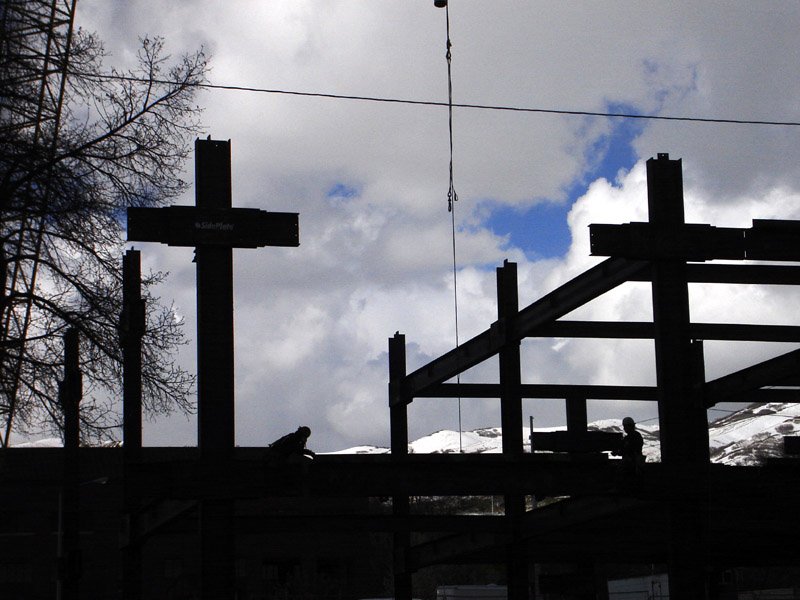
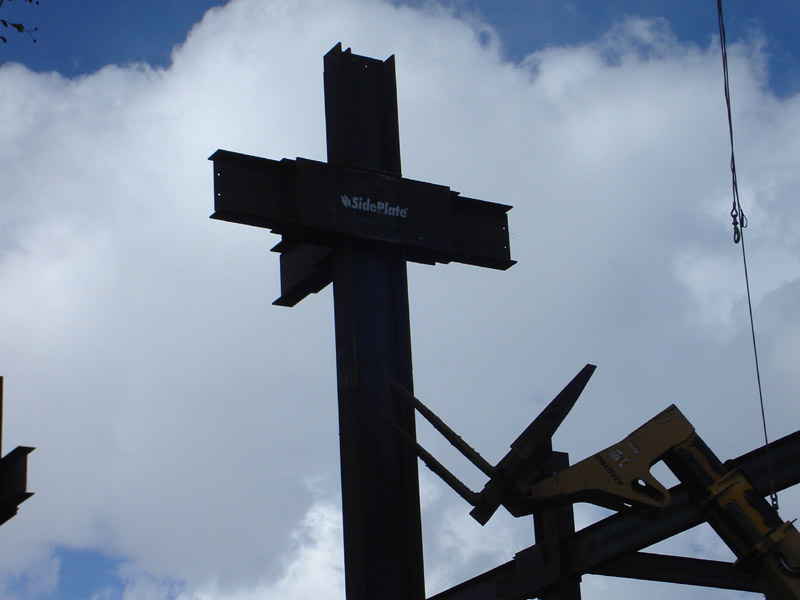
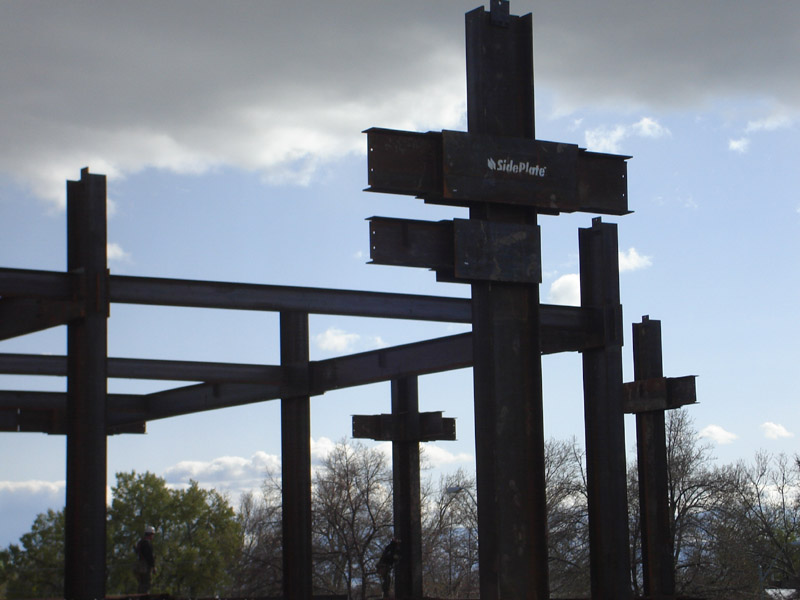
Consider the house above. Try to imagine not as a building which was designed by an architect for a client (in linguistic terms, not a purposeful message traveling between a "sender" and a "receiver"), but rather a structure, an utterance, which emerges gratuitously (as a "Gift") on its own, and develops in its own terms. No prior expectations about form, function or finish are in place, and so the house is free to develop interminably, as it will. That's exactly what most confused me about Gehry's corrugated-aluminum and chain-link buildings when i first saw them. Walking by the construction site, I couldn't imagine why it took the builders so damn long to complete a simple structure, until an architect friend of mine pointed out that the building was "done". What I took to be scaffolding, barriers and a foreman's mobile office was in fact the "finished" building. To have renovated this construction would have been no different from building it in the first place. The initial building was already an alteration. This is a very different way of viewing "living space": no longer as simply neutral Cartesian isometric space which you simply live it, space now is itself dynamic, alive.

Something I wrote to one of my freshman comp students:

I like very much your idea of comparing the clearly outmoded Architecture and Planning building here at the U to those of other programs on campus. I was a bit surprised you wouldn't have mentioned the Marriott dance building, because that is such a wonderful example of a building designed for a specific purpose, and which has aged wonderfully well. Also, I'm a bit concerned about your idealization of classic style, which reads a bit too much like von Humboldt.

...Rather than returning to romantic notions about the perfection of Greco-Roman culture, you might (as a truly 'catholic' planner) want to turn your attention to the medieval notion of design, building and use. If you consider the great cathedrals of Europe, you'll notice that these are structures which, for all that hey are unmistakably grand building projects, nevertheless everywhere violate classical notions of finish. They were built over large stretches of time, and used by the public all the while they were under construction. And quite evidently their plans were revised over the course of their construction. Many began as fortress-like romanesque buildings (quite like the A+P building at present) but over time became increasingly ornate, glassy and gothic.

If you were to adopt this post-modern view of things, you would be able to suggest that our our Architecture and Planning Building at the U, horribly outdated, not be completely overhauled, but rather put into a state of permanent revision, quite a bit like the Robert Morris title (which I've borrowed for the name of one of my class livejournals) suggests: Continuous Project Altered Daily. This is a concept you could address in terms of Aristotle's distinctions between contraries and contradictions: Some would assert that an architectural structure is either complete or incomplete, but rather than thinking in terms of such contraries, I would suggest that the same problem can be understood in terms of a contradiction. A building, then, might be considered as neither constructed or under construction but rather in a permanent phase of de-construction, or perpetually "under revision". Suddenly, cranes and scaffolding are no longer mere ugly nuissances, but rather occasions for us to perceive alternative forms of beauty and functionality, and to re-think building in terms of time in addition to eternity.


This is precisely what's going on right now with the Marriott Library, which is being modified even while it is in use. It strikes me that the A+P building might be the best place to educate the entire campus community with regard to the anti-modernist idea that finish is not the norm but rather the occasional exception, and that perpetual construction and demolition is in fact a more honest assessment of how cultures and their architecture actually live.


But to return to your own remarks, I think what you're saying about the impossibility of distinguishing between inside and outside in the Gehry house is entirely correct. This is a house while is all surface, but without any real inside or outside. This mode of construction is certainly what you see in the earlier Gehry works. By constrast, what you see in the later ones, those which made Gehry an architectural rockstar, is a different sort of confusion, or inversion: the reversal of background and foreground. Whereas /architecture/, or /space/, in the perspectival tradition, had been understood an established rational form outside of which loomed its irrational other, /cloud/; now, in Gehry's more recent works, /cloud/ is brought to the fore, while /architecture/ and /space/ are made radically to retreat and function merely as a ground against, or within, which /cloud/ can suddenly appear and hover. And, if you think about it, if not neo-mannerism, quite possibly such as reversal could be understood as a kind of neo-baroque "theatricality" (think Fried), the kind of thing you might associate with Racine. We'll talk about this more when we get to Diderot's "Rameau's Nephew".

Finally, some images to prompt reflection:


Torelli, with some help from me.


Fontebasso, Francesco (Venice, Italy, 1707–1769)
The Sacrifice of Iphigenia, c. 1749
Oil on canvas, 46 x 59 cm


Fontebasso, Francesco (Venice, Italy, 1707–1769)
Abraham and the Three Angels, c. 1750
Pen and brown ink over black chalk, red wash heightened with white


Lucilla Catania
"Ganci, Virgole e Doppie Punte," 1996
Galleria ARTRA,
Milano, Italy

Finally, have a look at these outrageous designs by Giuseppi Bibiena, in which /space/ and /cloud/ seem to merge together into one.

This is perfect day for reading Sei Shonagon.


Utagawa Hiroshige - 歌川広重
Oshashi Bridge & Atake In a Sudden Shower


James McNeil Whistler

Nocturne Blue and Gold - Old Battersea Bridge


John Cage

"In A Landscape"
"Daughter of The Lonesome Isle"
"Suit for Toy Piano - pt. One"

Sunday, March 14, 2010

The Mouth before The Voice: Food, Fantasies, the Mother

"Those who go below the surface do so at their own peril." - Oscar Wilde:

* * *

It is wearisome to hear once more that Roland Barthes' "Empire of Signs" is an example of hypocritical cultural imperialism. It's been said too many times; and, further, it's an inaccurate assessment of the actual text to begin with. I don't see the need to apologize for this book before recommending it - simply a need to introduce it in terms of what it actually pretends to accomplish as well as what it never imagined it could do. In a word, it's hardly as though Barthes was a Heidegger.


As a previous reviewer mentions, Barthes' shows his hand from the very beginning and does not attempt in the least to produce an objective or scholarly account of Japan. Who could be foolish enough to imagine that Barthes, who though he wrote none of his own was certainly no stranger to genuine historical and anthropological analysis; who could be foolish enough to imagine that Barthes would ever have considered himself here to have produced, spontaneously, a passable work of scholarship in a slim volume containing no documentation or critical notes whatsoever?

Barthes' writings, for all their diversity, began with a concentration on the sign as a unit of discourse, and the way signs become bundled into larger meaningful wholes. This a model, which though directed toward the analysis of the novel, nevertheless had it's basis in the concept of speech - which he saw in very abstract diagrammatical terms. Over time however Barthes began to pay increasingly greater attention to the materiality, the maternality, of the sign, in particular the written sign. Barthes' reading of Japan offers a vision of culture which is compelling insofar as it appears wholly different from that of the West, one which entails viewing all cultural activities as various forms of inscription as opposed to speaking. Barthes oppose Western logo-centricism (Word- and Voice-centered reality), then, to Japanese grapho-, or grammo-centrism (Writing-centered reality). Such a fundamentally inscriptive culture, highly ec-centric from the West's perspective, locates thought and action on the outside rather than the inside of the subject. It never assumes that action and communication (if those words apply here at all) take place in an natural and unmediated fashion, or in terms of a living and present Voice. Rather writing, speech and action are always intimately bound up with some technological or instrumental variant (sword, stick or banner) of the Pen.


If Barthes is working within any genre at all here, it's not that of scholarship but rather of the essay as first established by Michel de Montaigne. Montaigne's writings on indigenous Brazilians were in no way expected to provide an objective picture, much less construction, of the "rawness" of life amongst cannibals. Montaigne rather finds in the accounts he has heard of the Caribbeans an occasion to reflect on the concerns of his own culture, in particular epistemology, history and the value of the values of his own "over-cooked" civilization. Montaigne was well aware of what he was about, as was Barthes.

There is clearly no need to question the merit of thorough anthropological and historical research. However, those disciplines do not exhaust the possibilities of writing on other cultures. That we possess the methods necessary for the production of objective accounts of cultures, does not mean we no longer have a need for more subjective (or perhaps more non- or pre-objective) forms of investigation. Reason and the understanding, as Kant might have said, cannot take from the imagination what is its proper due.


It strikes me that the kind of phenomenological reverie evinced in Barthes' encounter with Japan (his "love affair" with chopsticks, which is openly fetishistic and evokes a dual, maternal phallus, an anti-Platonic phallus which is "not-One", which does not slice but rather unswaddles or snuggles a dumpling) is highly indebted not only to Montaigne's writings but also to Bachelard's later critiques of objective science. This sort of literary entry into a "paradis artificiel" does not come without a price. And certainly the cost of entry to, or residence in, this world of maternal jouissance was one which not only Baudelaire himself, but also numerous other writers, as antique as Augustine or as recent as Barthes himself, were perfectly willing to admit, and indeed to make the problematical focus of entire books and careers.

Barthes' "The Empire of Signs" is not only a welcome complement to more conventional scholarly writing, but is in fact conditioned and called for by it - as Barthes says elsewhere, the only proper response to writing is more writing. If Barthes had not written this book, someone else would have had to write it instead.

More Kant Troubles


Student:

I want to post a passage from Kant's Observations on the Feeling of the Beautiful and the Sublime (1764), one dealing with the character of non-European races.

"If we examine the relation of the sexes in these parts of the world, we find that the European alone has found the secret of decorating with so many flowers the sensual charm of a mighty inclination and of interlacing it with so much morality that he has not only extremely elevated its agreeableness but also made it very decorous. The inhabitant of the Orient is of a very false taste in this respect. Since he has no concept of the morally beautiful which can be united with this impulse, he loses even the worth of the sensuous enjoyment, and his harem is a constant source of unrest. He thrives on all sorts of amorous grotesqueries, among which the imaginary jewel is only the foremost, which he seeks to safeguard above all else, whose whole worth consists only in smashing it, and of which one in our part of the world generally entertains much malicious doubt -- and yet to whose preservation he makes use of very unjust and often loathsome means. Hence there a woman is always in a prison, whether she may be a maid, or have a barbaric, good-for-nothing and always suspicious husband. In the lands of the black, what better can one expect than what is found prevailing, namely the feminine sex in the deepest slavery? A despairing man is always a strict master over anyone weaker, just as with us that man is always a tyrant in the kitchen who outside his own house hardly dares to look anyone in the face. Of course, Father Labat reports that a Negro carpenter, whome he reproached for haughty treatment toward his wives, answered: "You whites are indeed fools, for first you make great concessions to your wives, and afterward you complain when they drive you mad." And it might be that there were something in this which perhaps deserved to be considered; but in short, this fellow was quite black from head to foot, a clear proof that what he said was stupid."

- Immanuel Kant, "Of National Characteristics, so far as they Depend upon the Distinct Feeling of the Beautiful and Sublime"

The gentleman in class who threw out the notion that Kant might have had a hint of racism probably experienced some shock while reading the last line of this passage. I certainly did. It's tough to twist that line and come out with something positive.

Teacher:

I know what you're saying about that last line. My response, though I don't know it to be correct, is this:

Was the shock deliberate? Is that line meant to be taken entirely literally or was it written for rhetorical effect? Was the shock not in fact something which was calculated in advance, intended to provide us with an initial jolt and then a subsequent opportunity to overcome the disturbance through rereading the passage ironically? In other words, is this sentence perhaps a miniature restaging of the Kantian dynamical sublime?

Honestly, it's hard to say. Not that Kant, when it came to race, held nothing but opinions which would be considered perfectly acceptable by today's political standards. But doesn't that final statement seem to come too unexpectedly out of left field? And doesn't it seem especially odd coming from a man who, above almost all things, prided himself on his lack of prejudice. The surprise appearance of the sentence, the effect of "parenthyrsis" (a term the 18th-century German art critic J. J. Winkelmann appropriates from Longinus' On The Sublime) might oblige us to suspend our judgment. Again, we must wonder whether Kant wasn't in fact asking if the reader, after considering all the manifold conditions which go into determining racial and regional character, would nevertheless be hasty enough to dismiss a man's opinion exclusively because of the color of his skin. Everything about the sentence would seem to suggest it is meant by the writer to stand out to us as a schoolbook example of faulty deduction.

Let me repeat, I don't know what the answer to this conundrum is. But the passage of Kant's which you raise for consideration comes from a man who was astoundingly well read, especially when it came to geography and ethnography of his day. The passage in question at once brings to my mind Montaigne's very famous essay about the newly discovered natives of Brazil, called "On The Cannibals." In it Montaigne ventures to argue that when the European and Brazilian cultures are freely compared without bias, it is in fact the Europeans who emerge as the more barbaric. Note how Montaigne clinches his point by ending his essay on a ironic note:
I had a very long talk with one of them; but I had an interpreter who followed my meaning so badly, and who was so hindered by his stupidity in taking in my ideas, that I could get hardly any satisfaction from the man. When I asked him what profit he gained from his superior position among his people (for he was a captain, and our sailors called him king), he told me that it was to march foremost in war. How many men followed him? He pointed to a piece of ground, to signify as many as such a space could hold; it might have been four or five thousand men. Did all his authority expire with the war? He said that this much remained, that when he visited the villages dependent on him, they made paths for him through the underbrush by which he might pass quite comfortably. All this appears to make good enough sense. But what's the use in? These people don't wear breeches.
Which is to say, "This supposed savage seems to speak reasonably enough. Still, who would be foolish enough to lend credence to a man who doesn't wear pants?


How much depends on the kind and degree of inflection we lend to the last line. I will freely admit that here we run into even further trouble, because in fact there is a scholarly debate over the proper translation of these last few sentences. (You can google various translations to see what I mean.) So, if Kant did indeed read Montaigne (and I would be very surprised if didn't) we still don't know how Kant's edition of the Cannibal essay read, (here's where you apply for grant money to fly to Königsberg to search Kant's library), much less how Kant himself read it.

In any case, this vexatious passage only confirms my point: before we hasten to pass judgment on such important issues, and especially when we're dealing with a declared free-thinker and a master stylist of astonishing intellect, we need to examine the evidence very closely. As it stands, the issue is not yet decidable for us.

And for what it's worth, it's just such a highly problematic and deeply disturbing detail which would make an ideal starting place for an essay in the style of Derrida.
From The Library Journal: "Following the death of Paul DeMan and the controversies surrounding the ensuing revelations of his personal life and wartime politics, Derrida delivered a lengthy seminar on the ethics and emotions of friendship. Each session began with the same plaintive refrain from Montaigne's essay on friendship: 'O my friends, there is no friend.'"


Hybridity, Monstrosity and Outrage in Late-Modernist Art

Click the image below and have a look at all the reverential and pandering nonsense PBS has to offer with regard the life and work of Robert Rauschenberg, a true American "master". Then conduct a Google search and have a look at Rauschenberg's actual art. This brief exercise will give you a wonderful lesson in what textual scholars call "redaction": retrospectively revising a text, or framing it, in order disguise its internal inconsistencies, as well as its inconsistencies with regard to its own historical context or our own contemporary values and expectations. Another way to refer to this smoothing and softening process might be "intellectual cowardice," a phrase which comes from the critic Susan Sontag.


Please, don't get me wrong; it's not at all that I think Rauschenberg was an insignificant figure in the least. It's rather that everything I have seen (in books and in person) and read (from genuinely critical sources) leads me to believe that Rauschenberg's actual project was not to contribute to but rather to destroy high culture, and in particular the institution of the Museum. His aim was always to replace reverence with loud laughter. Rauschenberg, like his associate the maverick musician John Cage, is almost always pictured smiling broadly and laughing heartily. But are these expression indicative of good-natured joy and human warmth? Or do they rather evince hostility and mockery, or perhaps simply an unashamed and unapologetic acknowledgment of the absurdity of most all we've been taught to respect?

Famed art historian Peter Berger summed up the issue in these terms:
In the begining was a smile, an irritating smile. . . . In vain, I seek a similarly apropos phrase to define the smile in question here that always appears on the lips of the advocates of poststructuralism when one intends to propose an argument. So arrives the thought that to understand poststructuralism means nothing other than to understand this smile.
Religious piety aside, are these artist laughing with, or are they laughing at Humanity? I propose this to you, as I have to all my classes in the past, as a serious question.


In any case, well-meaning idiots, like PBS, apparently never stop to ask themselves this question. Most likely because more often than not there's no immediate reward for being critical. And because they are two deeply mired in the self-congratulatory "Intellectual Traditions" ideology of which I have tried to remain skeptical throughout the semester - and in all my classes, not just this one.

This process of recension is one I want you to consider as we watch how the Christian Fathers gradually assembled a set of canonical books and orthodox teachings which, over time, functioned effectively to turn Jesus from a radical trouble-maker (of one sort or another) into a full-fledged conservative, something which by any responsible scholarly account he simply wasn't. And this, of course, is what the Museum mentality does to all lives and works of art and literature. Because these texts made an impact in their day, and because we feel a need to explain how our own current thoughts and practices derive from these pure sources, or simply because we like to congratulate ourselves for being cultured; we "interpolate" significant (and therefore potentially dangerous and unsettling) events from the past, until they become "Great Men", "Great Ideas" and "Great Books". Quite bluntly, I don't buy it. This mentality, no matter what you're been told and no matter how obvious and natural may seem, is the effect of an ideological system of which I am a renegade product. I will freely admit that I gained familiarity with intriguing texts through this sort of intellectual baby-sitting (precisely what Kant attacks as 'infantile' in "What is Enlightenment?"). But at a certain moment in my life I found it imperative to break away from what other people (some of them my institutional superiors) told me think. It became necessary to stand back from my education and ask myself, not how it ultimately made me "a better person" (zzzzzzzzz!), but rather what had it turned me into in the first place?


Some of you will wonder why I ask you to read not just great books but also minor ones. Some of you will wonder why we move so slowly. Some of you will wonder why I ask such pointless questions, or don't seem to present clear and definitive answers. Some of you will question what the whole point of the whole class is. Some of you, at the end of the semester, will write poor evaluations of the course; for a host of reasons, a quite frequently because it didn't look organized and professional along the lines of what you get in your science classes. But I would ask you to consider this: What does scientific research really look like? Does scientific research begin by assuming everything you feel to conform to common sense is actually the case? Or does not science actually begin by interrogating common-sense assumptions. Any scientific research proceeds according to method. The scientist works like an archaeologist; or a crime-scene investigator, who must not jump to conclusions or take anything from granted. Critical and methodical researchers must uncover not just what looks immediately interesting, but rather they must map out an entire site. Showing how two objects which look like they belong together were actually deposited thousands of years apart. Such researchers must get behind all the assumptions that have been handed us, until we see that reality (or at least the rational explanation of it) in fact works far differently from what common sense first tells us.

If you can begin to adopt this attitude with regard to our readings, you will have a enlightening and enjoyable experience in this course. If you simply want me to tell you what the "great writers" had to say so that you can say that you have studied "Intellectual Traditions" and therefore deserve to be awarded special "Honors" which distinguish you from the average student, then this class, though not necessarily intentionally so, is pretty much designed to make you utterly miserable. Oops! Whereas, if you want to begin to explore not just what we have been told to believe, but also how and why we have been told to believe at all, as well as what other alternatives to orthodox belief and behavior have arisen and are currently out there; then this class should be a fun and exciting adventure for you. At least that's my intention.


Robert Rauschenberg
Monogram. 1955-1959.
Moderna Museet
Stockholm, Sweeden

Monday, June 11, 2007

Abductions and Adductions of D&G with respect to the Academy


Abduction (kinesiology)


Abductive reasoning


In response to Erik's question about the ultimate success or failure of Deleuze and Guatarri's project within the university as well as society at large, I made reference to the the work of fate of René Thom, in particular his catastrophe theory. Here's the entire quotation of Thom's for which I was searching last night.
"Sociologically speaking, it can be said that this theory is a shipwreck. But in some sense, it is a subtle wreck, because the ideas that I have introduced gained ground. In fact, they are now incorporated in everyday language. . . . The notions of [catastrophe theory] have become part of the ordinary baggage of modelers. Therefore, it is true that, in a sense, the ambitions of the theory failed, but in practice, the theory has succeeded."
I believe the same can be said of the work of Deleuze and Guatarri. Nomadology never achieved its authors' ambition of a general cultural revolution, before being reterritorialized back into the institutional body from which they sought emancipation. Nevertheless, the variety of terms and concepts introduced by D&G, along with an at least provisional reorientation of critical outlook, have found their way into general scholarly practice, and perhaps as a result have made the institution a more highly articulated and agile body.


The Swallow's Tail — Series on Catastrophes
Salvador Dalí, 1983
Oil on canvas
73 × 92.2 cm, 28.74 × 36.30 in
Dalí Theatre and Museum, Figuere


This was the final painting created by Dalí, the last piece in a series based on René Thom's catastrophe theory (click for more info). Below is another painting in the same series.


Topological Abduction Of Europe - Homage To René Thom, 1983

Sunday, May 27, 2007

The Mass of Art Destruction

The gestural savagery of a multitude is individualized
to become the most remarkable manifestation
of ‘art made by all and not by one’.


–Jacques Villeglé


OK, I've been spending a lot of time locating music associated with Cage and Tudor, and I'll do my best to make at least some of it availible for you here. It's been interesting also to read about how quite a bit of this stuff, though it comes from out of the avant-garde, eventually rejects that "tradition" as elitist. Turning toward collective improvisation and socially accessible song, Cornelius Cardew in particular seeks to create a populist music which will activate the masses. To read his own statement on these matters, see his book Stockhausen Serves Imperialism.

Cornelius Cardew
The Great Learning
"Paragraph 2" (20:21)
"Paragraph 7" (21:51)


I'm sure each of us saw in reading Deleuze and Guatarri the other day quite a number of popular references, from novels, films (the Pink Panther, who paints the whole world pink) and music (Henry Mancini and "that ole man river, [that] just keeps on rollin' along"). It's easy enough to dismiss these as less-than-critical, if not outright embarassing. But I think it's important to acknowledge the extent to which Deleuze and Guatarri assemble their 1000 Plateaus out of bits and pieces (organs without bodies?) of the popular, or populist, landscape. This is very much in keeping with the visual practice of the day as exampled by the work of Jacques Villeglé, whose images (if we can even call them that) are the result of a multiplicity of anonymous acts of deterritorialization, each of which exists as a set of differential internal relations created through a multiplicity of uncoordinated external forces - sedimentation, scission, laceration, perforation, erosion, blanching, disintegration, and further sedimentation. In other words, in them we can glimpse production of art according to geological as opposed to organic forces.

(images by Villeglé, and more track from Cardew)


"Long Live Chairman Mao"


"Revolution Is The Main Trend In The World Today"


"Red Flag Prelude"


"The East Is Red"

Tropical Trysts


Below is a theoretical statement which, from Deleuze's perspective, would be almost exactly analogous to Freud's reductive reading of the Wolf-man. Though unlike Freud, it is willing to acknowledge, at least momentarily, the apparent multiplicity of nature; having made this admission, it nevertheless procedes immediately to move beyond this in the interest of indentifying a unified structure.
Every landscape appears first of all as a vast chaos, which leaves one free to choose the meaning one wants to give it. But, over and above agricultural considerations, geographic irregularities and the various accidents of history and prehistory, the most magestic meaning of all is surely that which precedes, commands and, to a large extent, explains the others. A pale blurred line, or an often almost imperceptible difference in the shape and consistency of rock fragments, are evidence of the fact that two oceans once succeeded each other where, today, I can see nothing but barren soil. As I follow the traces of age-old stagnation despite all obstacles - sheer cliff faces, landslides, scrub and cultivated land - and disregarding paths and fences, I seem to be proceeding in meaningless fashion. But the sole aim of this contrariness is to recapture the master-meaning, which may be obscure but of which each of the others is a partial or distorted transposition. . . .

When I became acquainted with Freud's theories, I quite naturally looked upon them as the applications, to the individual human being, of a method the basic pattern of which is represented by geology. In both caes, the researcher, to begin with, finds himself faces with seemingly impenetrable phenomena; in both cases, in order to take stock of and gauge, the elements of a complex situation, he most display subtle qualities, such as sensitivity, intuition and taste. And yet, the order which is thrus introduced into a seemingly incoherent mass is neighter contingent nor arbitrary. Unlike the history of the historians, that of the geologist is similar to the history of the psychoanalyst in that it tries to project in time - rather in the manner of a
tableau vivant - certain basic characteristics of the physical and mental universe. I can take the simile of the tableau vivant further: the game called 'charades' provides a simple illustration of a procedure which consists in interpreting each action as the unfolding in time of certain eternal truths, the concrete aspect of which in other fields are referred to specifically as laws. In all these instances, the arousing of aesthetic curiosity leads directly to an acquisition of knowledge.

-- Claude Levi-Strauss, Tristes Tropiques
What interests me in the SI cover above, aside from the obvious, is the way the image is composed out of various layers of photograph and text, each of which we created at different moments and brought together after the fact. The effect achieved by this conjunction is a figure which seems tissue thin and to be hovering in empty space amongst other paper cuttings situated at various distances. Notice how the effect of depth does not entail a gradually and continuously receding space but rather number of planes, a quantized space in which they eye must leap suddenly from stratum to stratum. Here space is not a neutral container which happens to house these objects. Rather, the objects are prior to space, and whatever space exists is the pure function of the relations between the various strata formed by the various objects. This is a pure fantasy space, like the Freudian primal scene, a constructed vision which can be made to pop into bold relief and startling apparent presence - and always at the cost of going blind to the composite nature of the construct. How to liberate oneself from this mesmerizing effect? Flatten the image, reducing it to (n -1) dimensions.

The point of course is that nature does not have a face, that the picturesque landscapes which 19th-century Natural Theology saw as indisputable evidence of the creative artistry of God, are not in the least products of any divine intention or inner unifying developmental force, but rather the conflictual result of an vast array of uncoordinated external forces. Deleuze and Guatarri's argument is that not only do we err in imposing organic metaphors onto nature, but additionall and as significantly, we err in imposing organic metaphors onto organisms.

Thursday, May 17, 2007

My Article Finally Made It On Line

This is hardly what I'd call high-profile. But at least one of the editors read it. Have a gander.

A Goat is A Goat is A Goat:
No Narrative in "New Narrative"


Online Exclusive / Posted May 9, 2007

But do we really need art criticism? It occurred to me while attending a recent exhibit at the Salt Lake Art Center, that the answer is yes. In "New Narrative: Warhol, Stella, Marden, Fitzpatrick,” I was surprised to see the works of very different artists presented as if they were all variations on a single theme - narrative. But where, in the midst of what struck me as a forced conjunction of austere mono-prints, slick poster-Pop, playful collages and Mexican lottery tickets, was the unifying narrative, or for that matter, any narrative at all?

I do not demand either unity or narrative from art. I am aware that beginning with Robert Rauschenberg's "combines" of the mid-50s, the art world gleefully abandoned its high-modernist pretensions to stylistic unity, and turned to experimentation with hybrids. Artists began to mix and match, juxtapose and provoke, promote direct political action as well as communal interaction. Gone were the good old days of abstract expressionism. Gone were Jackson Pollock, Franz Kline and Mark Rothko - artists who sought to produce godlike presences, icons of themselves. Instead, postmodern artists pandered spectacle and theatricality. This new wave of artists cashed in their stock in the genuinely rare and came instead to value the rarity, the novelty, the curiosity, whatever was simply quirky and hip. Where the unique and original once was, now there is the popular and the copy.

This decisive turning point was identified with great clarity by renowned art scholar Michael Fried. In his landmark essay of 1962, "Art and Objecthood," Fried declares painting to be on the verge of exhaustion. And Frank Stella (amongst other key painters such as Kenneth Noland, Morris Louis and Jules Olitski), Fried proclaims, is the chosen one who will either save painting or die trying. Fried identifies painting’s enemies as a new group of artists (Tony Smith, Donald Judd, Carl Andre) known as the minimalists, or literalists. These artists cheerfully reject the old Renaissance tradition that paintings are windows to imaginary worlds. Instead of paintings or even traditional sculptures, they sought deliberately to produce mere objects, brute and banal cylinders and cubes that simplely get in the way. Gazing in rapt admiration upon such chunks of wood and stone would be as misguided a response as admiring the aesthetic qualities of a parking stall or a traffic pylon.

The genius of Stella's breakthrough paintings, at least as far as Fried is concerned, lies in their ability to present powerfully compelling abstract images, while at the same time never denying the fact that these images rely upon physical supports, the very real boards or canvases they're painted on. Stella's images consist of nested squares or nestled wedges, whose shape is entirely determined by the shape of the canvas. Here, image and support mutually imply and sustain one another, producing the effect of perfect simultaneity. They can be fully seen and perfectly understood in a single instant of intuition. And where there is no time, there can be no stories.

Now, let me turn to the show up for discussion: New Narratives. In looking at the Warhol prints in his Ten Famous Jews from the 20th Century series, I can't help but notice their close resemblance to Picasso's portraits and neo-classical drawings from the 20s and 30s. Then I turn specifically to the portrait of Gertrude Stein, which had it not been conveniently labeled I might well have taken for a portrait of Julius Caesar. Stein was one of Picasso's closest friends and the subject of one of his most famous paintings. Warhol is obviously quoting Picasso, but not in subject matter alone. The bold patches of color unmistakably recall Picasso's use of real scraps of wallpaper in his drawings to signify texture, depth, and shadow and light. More important however, is Warhol's use of rapidly drawn outlines. These mark out only the most essential features of his subjects, and give the drawings the look of the ancient Greek or Etruscan vases, which Picasso admired. Warhol, in swiftly tracing over photographic images, is glibly quoting Picasso's neo-classical style.

Picasso turned deliberately toward myth, in particular the wild transformation stories from Ovid's Metamorphoses, in order to counter the growing belief that as a cubist he was trying to cultivate a style, which was perfectly timeless, which had nothing to do with narrative. Warhol, on the other hand, in total opposition to Picasso, strategically pirates the master's style, and uses it, insolently, to produce a series of bust shots, which have all the gravitas of collector’s-edition Big Gulp cups. Warhol has expunged all depth, narrative and history from his images of modern mythical figures. He produces neither archetypes nor ambivalent dream images, but simply multiple prints of celebrities. Certainly we are shown the classicized faces of important Jews, both men and women. But Jews here are completely dissociated from anything that might allude to their actual historical achievements. Images of Einstein, Gertrude Stein and Justice Brandeis are placed on equal footing, or better said, given equal billing, with Sarah Bernhardt and The Marx Brothers. Rather than for founding states, splitting atoms, or interpreting the law, these Jews are famous simply for being Jewish. Here, greatness is stripped of all grandeur, the heroic stripped of mighty deeds. Fashion photographer that he is, Warhol mechanically copies (again, by literally tracing faces marked by "Roman" noses) the superficial characteristics of classicism. But what he admires is not any inner spirit so much as a deathly coolness. And there the issue ends. There is no story.

As for Frank Stella's contribution to the show, his 11 illustrations of Had Gadya, the shows brochure informs us, are based on an earlier series of prints by Russian artist El Lissitzky. Now, Had Gayda is a traditional Passover song, usually sung to help keep children awake and amused during the nighttime vigil. The song, which is literally about a baby goat, operates on the same principle as "I Know An Old Lady Who Swallowed A Fly." Originally, the patently absurd lyric had no particular significance. Soon enough however, clever scholars, searching for interpretive fodder, insisted the story must mean something more. Thus began the effort to interpret a nonsense rhyme symbolically, allegorically: "the goat clearly represent the chosen people, and so obviously the hungry cat that eats the goat represents.. yiddle-diddle-dee, yiddle--diddle-dum (acknowlegements and apologies to Susan Sontag and Sarah Silverman).

Now, Lissitzky was a student of the deeply religious Suprematist painter Kasimir Malevich, and he may very well have been drawn to the idea that cryptic meanings could have been encoded within the words of a children's song. His illustrations of the song in fact resemble the mystical fantasies of Marc Chagall far more than the crisp graphic designs usually associated with him, and they certainly seem to share in the spirit of Jewish mystical allegory. But Stella's prints, on the other hand, conceive of allegory in a completely different manner. Here, rather than understanding allegories as images with a symbolic meaning in excess of what they immediately show, allegory is instead completely emptied and flattened. Allegory, for Stella, means simply an image, which cannot be seen and understood (as Fried would have wanted) in a single instant. Allegories are those images, which, by virtue of there of excessive busyness, glitter, splash and hybridity, require the viewer to perceive them in pieces and over time. The goat in Had Gadya, according to Stella's view of things, is neither more meaningful or less literal than the salvaged goat in Robert Rauschenberg's notorious Monogram. Stella's allegory is depleted of all allegoricity, which is to say emptied of all spirituality and meaning, and emptied of all narrative.

As for the other two artists represented in the show, Brice Marden and Tony Fitzpatrick, their work, like Stella's, makes sense to me insofar as it experiments not so much with narrative as with the notion of the support. Though Marden and Fitzpatrick work in very different styles, their medium, at least in the pieces on display in this show, is the same. Both artists use printed etching to produce works whose graphic quality possesses not the commercial slickness of Warhol so much as that of a deliberate craftsman such as Rembrandt. The actual marks they make, rather than suggesting a photographer's grease pencil, attest to their use of the engraver's metal burin.

A further attribute of their work, derivative of the printing process, is the presence of square embossments. One can see here how the pressure applied to the print surface has left a shallow relief, which surrounds and frames the images. In the highly austere, and to my eye highly sensitive, series of unnamed prints by Brice Marden, this slight but unmissable trace of the production process is fully integrated into the image and functions to create the effect of a window through which the viewer is invited to look. The flatness ordinarily associated with graphic work is thus suspended, at least momentarily, and one feels oneself returned to the visual space of abstract painting.

This effect is powerfully reinforced through other compositional means employed in Marden's prints. The series begins with images composed of simple horizontal lines and textured bars, unmistakably evocative of horizon and sky. These are examples of a printer working with the vocabulary of landscape. Approaching and retreating from the images allows the viewer to elicit differing visual effects from the prints, suggestive either of the atmospheric depth, which I have already mentioned, or of the flatness normally associated with a print.

Once this set of expectations, or codes of viewing, has been established in the first prints, Marden then proceeds, in the following images, to frustrate the viewer's ability to play with these effects, by multiplying the number of horizontals and exchanging them for verticals. The viewer is left, then, with a series of visual utterances employing the basic vocabulary of landscape, though no longer adhering to the conventions of landscape's visual grammar. To view the later prints in Marden's series is feel the window, or perhaps door, the artist had opened for us in an initial gesture of welcome, and which he had allowed us freely to adjust, to begin, with an ever-increasing amount of pressure, gradually to close. They shut us out and shut vision down.

That there is a motivation behind this sequence of images is hard to doubt. But that mere sequence amounts to a veritable narrative seems far less certain. Overtly experimental as Marden's prints are, it seems unreasonable that we should be expected to see them in narrative terms any more than we would be justified in reading narrative into a series of blood tests. There may indeed be a real human story behind the elevated level of toxins found in my blood stream at a given moment, or my decreasing ability to read an eye chart. But seen strictly from the perspective of experimental medicine, all that matters are visible effects and their demonstrable causes. Here, once again, there is no narrative.

Finally, I want to turn to the work of Tony Fitzpatrick. This very contemporary artist offers a series of prints, which in a nod to the baroque philosopher Blaise Pascal, is called “The Infinite Wager.” Fitzpatrick’s prints also integrate the embossed trace of the printing press into the image itself. But in this instance the effect is quite different from that achieved in Marden. Fitzpatricks’s compositions, which combine elements of cartoon, bathroom graffiti and third world devotional art, are emphatically flat; they make no reference, not even a negative one as in Marden, to easel painting. Instead, they announce themselves as the work of an amateur or primitive. Which is why I must chuckle, not at, but with the Fitzpatrick, when he archly advertises himself as “fine artist.”

In embracing the naïve, Fitzpatrick’s work shows a certain affinity with Warhol. In place of Andy’s cool interest in glamour though these pieces derive what little mystique they have, from Fitzpatrick’s postmodern appropriation of the vernacular of folk art, superstition, white-trash culture – skulls, devils, serpents, pinup girls, whiskey bottles and playing cards. Of course, this repertoire of images is the stock in trade of prison art. And consequently I want to read the embossing in these images, the visible trace of the press, as evoking the pressure entailed in producing a tattoo. Here the engraver’s burin is metaphorically transformed into the skin artist’s needle.

It would be almost impossible to look at Fitzpatrick’s prints without having images of old school flash-art come to mind. What distinguishes Fitzpatrick’s images drastically from real tattoos, and simultaneously lessens their impact, is the obvious fact that they are not pricked into skin but instead pressed onto paper. In the same way that their iconography can not be taken literally but instead displays a sense of ironic detachment (for clearly the artist’s interest in games of chance reflects not a belief in metaphysical Fate but rather in simple accident and coincidence), the intense pressure indicated by the printing mark refers not to any painful bodily ordeal but simply a physical process undergone by an inanimate substance. Paper may indeed be a kind of tissue, but it is certainly not a sensitive living membrane. At the same time Fitzpatrick offers us superstition emptied of all belief, he simultaneously offers us images of experience emptied of all ordeal, which is to say “experience” emptied of all experience – either in terms of a painful event commemorated with a tattoo, or the actual pain produced by repeated jabs from a needle.

Or, even if we do choose to feel some vague pathos in Fitzpatrick's use of paper as surrogate skin, it is still not possible to read the random assemblage of assorted images as the result of any purposive process. The living body here would offer itself not as a surface bearing monumental inscriptions so much as a simple scratch pad or bulletin board - the kind of outrageous absurdity depicted in the Christopher Nolan film Memento, whose traumatized protagonist is decidedly handicapped when it comes to forming coherent narratives. Image this same film, but without the precipitating crime, and you have the art of Tony Fitzpatrick. Rather than creating and playing with the idea of depth, the stamping marks in Fitzpatrick's pieces, then, emphasize their absolute superficiality. If narrative, to function as narrative, requires some kind of stakes, the stakes in "Infinite Wager" strike me as decidedly, if not infinitely, low.

Certainly we all do, and should, see art in our own unique and powerful ways. However, it seems to me that our response to art is never so powerful or significant as it is in those moments of insight when we not only know we like something but also suddenly find ourselves able to explain, to others, and ourselves what precise quality in a work of art has captured our mind or imagination. In these statements, the work suddenly takes on an increased meaning and reality for us. And so we should be careful in how we talk about works of art, because the words we use to talk about them soon become an actual part of them. Criticism is not an individual activity. It can only function properly in communities in which statements are frequently exchanged and opinions revised. If these conditions are not met criticism does not disappear; it hardens into dogma, while opinion turns into mere claptrap. We become so accustomed to using certain fashionable words, narrative being just one of them, that we begin finding an opportunity to use them anywhere, and cease questioning their appropriateness when we hear them, or see them brightly printed onto free brochures.

Wednesday, May 16, 2007

Electric Guitar

The new metal dude in the building would definitely benefit from a dozen or so lessons, at least. I don't suppose anybody will be writing an ode on his playing any day soon. Rock on, dude. Just not so loud.

The Neighbor

[Stringed instrument], are you following me?
In how many distant cities has your
lonely night already spoken to mine?
Are a hundred playing you? Or just one?

Are there in all the great cities of the world
those, who without you, would have
already lost themselves in the rivers?
And why does it always have to concern me?

Why am I always the neighbor of those
who in fear force you to sing
and to say: The heaviness of life
is heavier than the heaviness of all things.